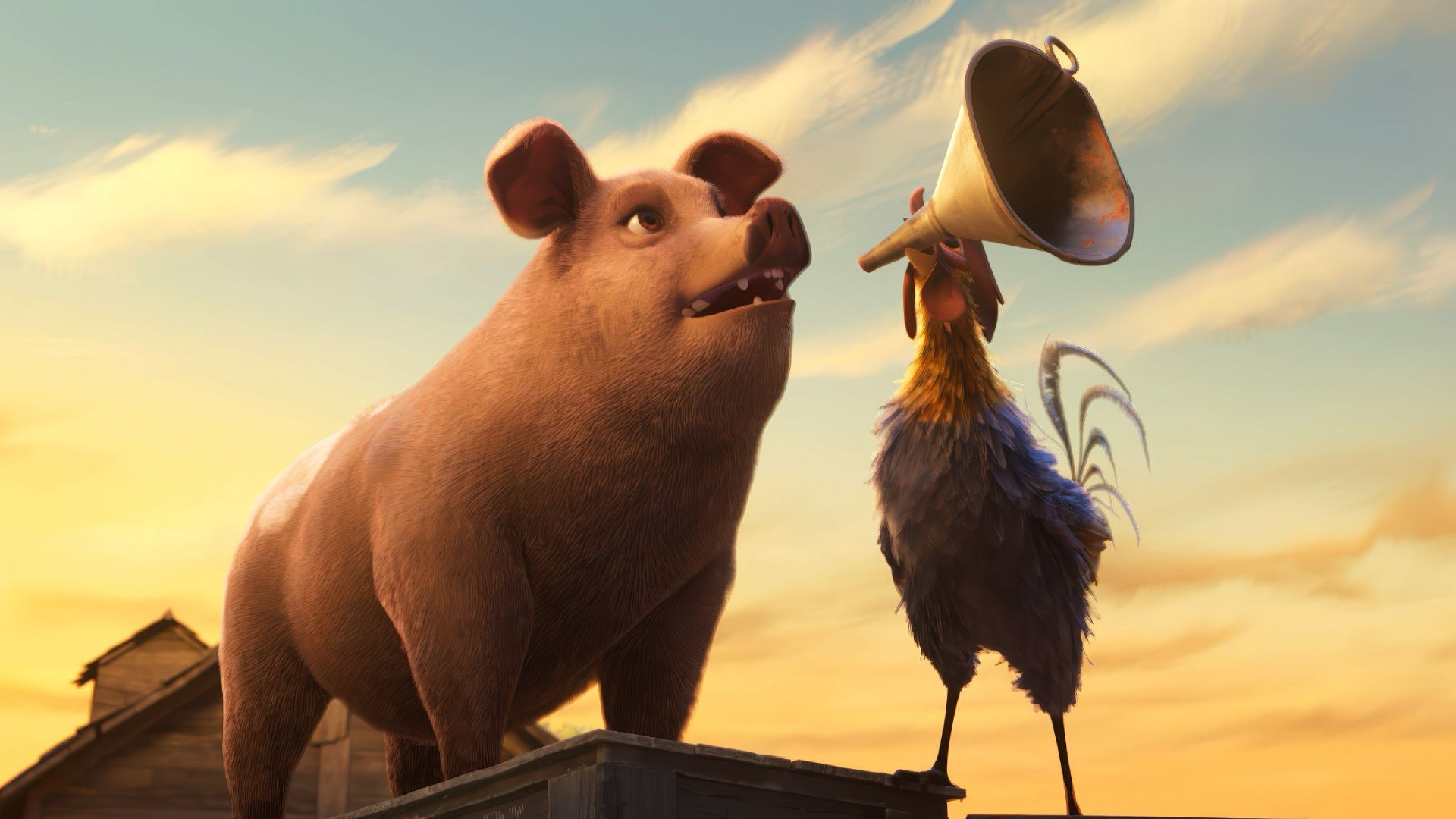
A fresh take on George Orwell’s classic novel, originally published in 1945, is currently in cinemas. Directed by Andy Serkis, this animated film is sparking debate among both critics and viewers as it tries to connect Orwell’s sharp critique to today’s political landscape. Though it’s not universally loved, the film is definitely getting people to think and talk about important issues.
If you loved the new Animal Farm movie and want to explore similar themes, or if you weren’t quite satisfied and are looking for something more, there are many excellent dystopian books to choose from. These stories offer thought-provoking social critiques and cautionary tales about the future, making them perfect reading material after experiencing Animal Farm.
Everyone Needs to Read Animal Farm (Whether or Not They’ve Seen the Movie)
Despite what you might think after seeing the new film, it doesn’t quite capture the power of George Orwell’s original story, published in 1945. The book was a direct critique of the Russian Revolution – how it replaced a ruler with a communist government that ended up being even more controlling. The movie borrows some ideas from this, but its attempt to update the story for modern audiences doesn’t fully work.
If you’ve seen the new movie based on Animal Farm, it’s worth reading George Orwell’s original book to truly understand its message. The story is a powerful look at revolutions and how they often end up creating the same problems they were meant to solve. The movie does a good job with some of these ideas, but the book offers a much deeper and more complete understanding of Orwell’s thoughts.
The Giver Imagines a World That Has Lost Its Culture
Lois Lowry’s 1993 novel, The Giver, tells the story of a seemingly perfect society that maintains peace and unity. But this peaceful life comes at a cost: the community has eliminated cultural richness and deep emotions. All of humanity’s history is preserved by a single person called the Giver. When twelve-year-old Jonas is chosen to be the next Giver, he starts to understand that the community’s focus on sameness has taken away people’s unique qualities.
The Giver builds on ideas explored in books like Brave New World. It asks whether a perfect society is truly desirable if it requires sacrificing important parts of what it means to be human. The novel celebrates the full range of human emotions and experiences, even the difficult ones like pain and struggle. While a 2014 adaptation exists, Lois Lowry’s original book remains a valuable and thought-provoking read.
Brave New World Warns About Utopia That Comes at a Price
As a huge sci-fi fan, I recently read Aldous Huxley’s Brave New World, published way back in 1932, and it really stuck with me. The story is set in this future place called the World State, which seems perfect on the surface – everyone’s happy and things are orderly. But that ‘perfection’ comes at a cost: people aren’t really individuals. They’re essentially created in labs, raised to fit specific roles, and kept content with a drug. Then this outsider, a guy named John the Savage, gets brought into the mix, and suddenly some people start questioning whether this so-called utopia is actually all that great.
Aldous Huxley’s Brave New World is a thought-provoking exploration of the tension between personal freedom and a seemingly perfect society. The novel asks whether true peace and stability are possible without sacrificing what makes us individuals, and if the price of a utopian world is simply too great. Despite being published nearly a century ago, the book’s ideas still resonate strongly today.
Divergent Is a Great Introductory Series for Potential Fans of Dystopian Books
Veronica Roth’s Divergent takes place in a future Chicago where people are divided into five groups based on their personalities. Sixteen-year-old Tris Prior finds out she doesn’t fit neatly into any one group – she’s “Divergent,” meaning she has traits from three. She tries to hide this, but as conflict grows and a dangerous plan unfolds, Tris realizes that she and other Divergent individuals are the key to saving the city.
While it occasionally simplifies the story’s ideas, this book is a great introduction to dystopian fiction and offers plenty more to read for those who get hooked. It’s the first in a trilogy, followed by Insurgent and Allegiant. There’s also a companion novel, Four, which tells the story from a different character’s point of view, plus a short story that wraps up the original trilogy. Recently, the author announced another book, The Sixth Faction, exploring a ‘what if?’ scenario with a different choice made by the main character.
The Handmaid’s Tale Is a Harrowing Prediction of America’s Future
Margaret Atwood’s novel depicts a frightening future where the United States is controlled by a harsh, totalitarian regime that severely limits women’s rights. In this patriarchal society, many women are forced into the role of “Handmaids,” whose sole purpose is to bear children for the powerful men in charge. The story, published in 1985, centers on Offred, a Handmaid who bravely resists this oppression.
What makes The Handmaid’s Tale so chilling is how easily its frightening world could happen today. Unlike many dystopian novels set in distant futures, Atwood’s story shows how quickly a society can fall into a totalitarian regime. It’s a gripping and terrifying read that has also become a popular and highly praised television series.
Maze Runner Presents a Baffling Mystery at the End of the World
This story centers around a group of boys stuck in a huge, complex maze with no obvious way out. When a new boy named Thomas arrives with no memories of his past, he becomes determined to solve the Maze, uncover how they all ended up there, and discover their purpose. The initial book is followed by The Scorch Trials and The Death Cure, along with several prequel stories and a movie series.
Although The Maze Runner is the best book in the series, the deeper, more troubling ideas about a broken society don’t fully emerge until the following books. It’s revealed that Thomas and his friends are part of a cruel experiment run by a company trying to find a cure for a deadly global illness. They have to grapple with their role in this scheme and decide if helping to save humanity is worth the cost. James Dashner’s trilogy tackles fascinating topics like the dangers of unchecked corporate power, fighting back against injustice, and the ultimate sacrifice, and it continues to be a popular example of dystopian fiction.
Station Eleven Prioritizes Culture in the Aftermath of Disaster
Emily St. John Mandel’s 2014 novel, Station Eleven, takes place in a world devastated by a flu pandemic. The story follows a troupe of actors who travel and perform Shakespeare and classical music twenty years after the outbreak.
I absolutely love Station Eleven. It’s not your typical post-apocalyptic story; it’s a really thoughtful look at what matters after everything falls apart. What I find so special about it is how it focuses on art, culture, and finding meaning, things a lot of other stories in this genre skip over. The story itself feels small and personal, which I think is brilliant. It’s easy to connect with the characters because they don’t feel like they’re trying to save the world, just navigate it, and that feels really real. Plus, there’s a fantastic miniseries from 2021 based on the book!
Fahrenheit 451 Presents a Surprisingly Accurate Future
As a huge movie and book fan, I’ve always been fascinated by Ray Bradbury’s Fahrenheit 451. It imagines a future where the government has banned books – can you believe it?! They keep everyone happy and controlled through constant entertainment and the media. The story follows a guy named Guy Montag, who has the job of burning books, but he starts reading them in secret. He quickly realizes his society is keeping important knowledge hidden from everyone, and it’s a really thought-provoking ride.
Ray Bradbury’s Fahrenheit 451 highlights the value of independent thinking and learning, drawing parallels to the book burnings of Nazi Germany. The novel also cautions against becoming too dependent on easily manipulated digital media and the dangers of being distracted by shallow entertainment. The recent adaptation of Fahrenheit 451 demonstrates that the story’s message remains relevant and powerful today.
1984 May Be the Most Important Dystopian Book Ever Written
George Orwell’s 1984 is a groundbreaking dystopian novel, published in 1949, that imagines a future society. In this world, the all-powerful Big Brother controls everything, dictating people’s thoughts and manipulating history to maintain power. Those who disagree, or even think differently, are either forced to conform or face severe consequences.
George Orwell’s 1984 remains a powerful and relevant novel, continuing to influence our culture long after its publication. Its bleak vision of the future resonated deeply in the years following World War II and the rise of totalitarian regimes, and it still feels strikingly current today. Fans of dystopian fiction will especially appreciate this classic work by Orwell.
The Hunger Games Is the Best Dystopian Story of the 21st Century
Set in a dark future of the 21st century, Suzanne Collins’s novel unfolds in what was once North America. A powerful city called the Capitol controls the land, and the rest of the continent is divided into twelve poorer districts. As punishment for a past rebellion, the Capitol forces each district to send two teenagers to compete in the annual Hunger Games – a brutal fight to the death where only one survives.
Suzanne Collins’s The Hunger Games trilogy—The Hunger Games, Catching Fire, and Mockingjay—delves into powerful themes like rebellion, the manipulation of information, and what it means to be a hero, all seen through the compelling character of Katniss Everdeen. Collins’s insightful political observations and skillful writing revitalized the dystopian genre and paved the way for popular series such as Divergent, The Maze Runner, and Red Rising. Beginning with a single novel, The Hunger Games has grown into a large franchise, encompassing six books and a film series that has earned over $3 billion.
Found an error? Send it so it can be corrected.
Read More
- Золото прогноз
- 9 Best Western & Neo-Western Movies Released Since 2000
- НИТЕЛ акции прогноз. Цена акций NTZL
- 5 Perfect American Sitcoms
- Фунт обгонит доллар? Эксперты раскрыли неожиданный сценарий
- Steam Drops New 100% Free Game That You Can Keep Forever
- Malcolm in the Middle Becomes a Disney+ Hit in the U.S. 2 Weeks After Revival
- 8 Romantasy Book Duologies That Deserve TV Adaptations
- Doctor Strange Has the MCU’s Most Unique Movie Ending
- Джетленд Холдинг акции прогноз. Цена акций JETL
2026-05-02 00:10