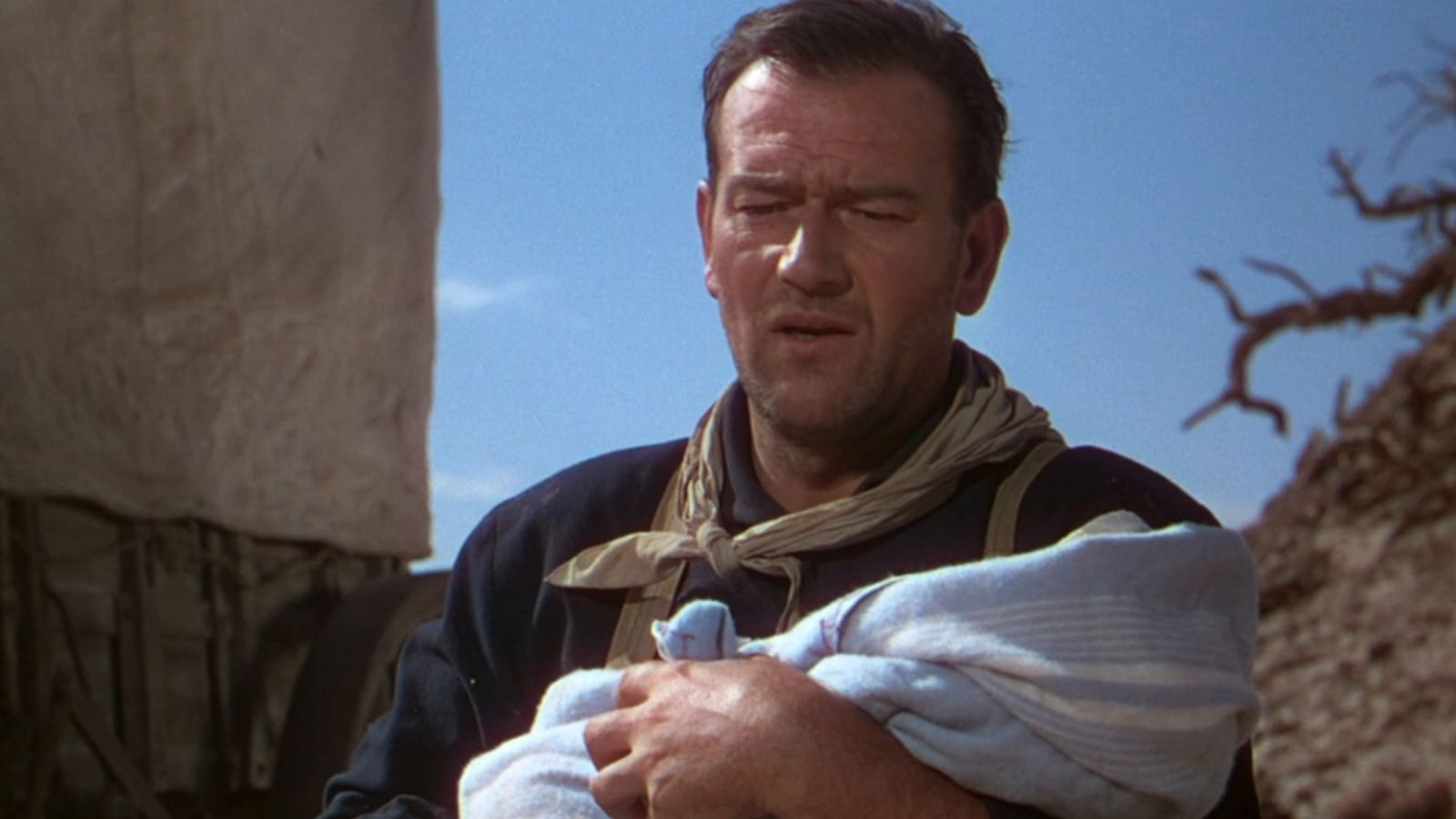
John Wayne became a Hollywood legend thanks to classic Westerns like Stagecoach and Fort Apache, and continued to star in acclaimed films such as 3 Godfathers. Working with celebrated directors like John Ford, he built a reputation as the quintessential American hero, often portraying strong, silent lawmen and adventurers in the Wild West. Even after a 77-year career, one of his films remains a beloved Christmas classic.
John Wayne is instantly recognizable as a Western icon. Before stars like Clint Eastwood and Charles Bronson, he was America’s original action hero for many. He famously portrayed classic Wild West characters, such as Rooster Cogburn and Sheriff John T. Chance. Many consider his 1948 film, 3 Godfathers, a hidden gem, and it’s a compelling story inspired by the traditional Christmas narrative.
How John Wayne Defined the Wild West in Hollywood
John Wayne became a major Western star after playing the Ringo Kid in John Ford’s 1939 film, Stagecoach. The movie was a hit, and he quickly became the most recognizable face of Westerns in Hollywood, often outshining even established actors like Henry Fonda and Robert Mitchum.
As a film critic, I’ve always been struck by this actor’s incredible range. He could convincingly play anyone – from rugged cowboys and quick-drawing gunslingers to steadfast lawmen and brave soldiers – and he consistently delivered. Looking back at his career, spanning from 1939 until his passing in 1979, it’s amazing to see that he starred in at least one truly unforgettable film every decade. We’re talking classics like The Searchers, the brilliantly paced Rio Bravo, and, of course, his Oscar-winning performance in True Grit. A consistently compelling performer, without a doubt.
In all his films, John Wayne consistently showcased his personal beliefs about what made a good movie, establishing himself as an icon of American manhood. He disliked seeing characters die on screen and always chose roles that promoted positive values, which helped him gain a huge following. While he wasn’t perfect, his lasting impact on Western films is undeniable.
It’s no surprise that Wayne created some of the most memorable and impactful characters in Westerns. While some might see his roles as overly nationalistic or simple, that wasn’t often true, especially because of the talented directors and writers he collaborated with. In fact, many of his best performances delved into important themes like bias, accountability, and the power of guidance.
Wayne became a major star between the 1950s and late 1960s, earning huge box office success during that period. While his films from the 1940s aren’t as well-remembered today, they actually include one of his best movies: 3 Godfathers.
3 Godfathers Gave John Wayne a Christmas Masterpiece
In 1948, filmmakers released a new adaptation of Peter B. Kyne’s classic novel, Three Godfathers. The story, a Western favorite, had been made into a movie several times before, with a new version appearing roughly every ten years from 1916 through the 1940s.
Ford’s story begins when three outlaws – Bob Hightower, Pedro, and Will ‘the Abeline Kid’ – arrive in the Arizona town of Welcome. They’re secretly plotting to rob the bank, and are quickly met by the town sheriff, Buck Sweet. After the robbery, Sweet gathers a posse and pursues them into the desert, relentlessly tracking them even when they disappear from view.
Everything changed for us when we stumbled upon a woman in a wagon, barely alive and just having given birth. It turned out she was Sweet’s niece! With her last breath, she named the baby boy after all three of us, making us his godfathers. It was heartbreaking, but we knew we had to take care of him.
Now cornered and unable to keep running, they start to reconsider their actions, realizing that the most important thing is the baby’s safety. Still wanting to avoid capture, they head for New Jerusalem, hoping to find someone to care for the infant so they can escape the pursuing group.
I’ve come across a really unique take on the story of the Three Wise Men, but set in the Wild West. It focuses on the three men themselves – they’re not exactly heroes, and they’re facing some tough decisions as they try to protect the baby. It’s surprising, because Westerns are usually all about gunfights and tough guys, but this story is actually really touching and emotional. It’s not about a cowboy with a gun or a sheriff enforcing the law; it’s a bittersweet journey where these three men discover something worth living for out in the West.
It’s rare to see Christmas featured in classic Westerns, so when it appears alongside figures like John Wayne, it really stands out. This demonstrates the genre’s flexibility and shows that stories set in the Wild West – like the one by Kyne – tap into the core of American storytelling and imagination.
The 1936 Version of 3 Godfathers is Woefully Underrated
Kyne’s novel has been adapted for film several times, including versions released in 1916 and 1929, the latter titled Hell’s Heroes. A 1936 adaptation starred Chester Morris as Bob Sangster, but it remains less well-known compared to Ford’s famous film.
This version of the story unfolds at a deliberate pace, prioritizing character introspection and moral themes over action. It centers on the heroes’ regrets, inner conflicts, and evolving philosophies as they come to terms with their fate and protect the child.
While the 1936 film, directed by Richard Boleslawski, isn’t as powerful or grand as the one from 1948, it stands out in one important way. The earlier movie has a more poignant and melancholic ending: instead of a happy conclusion, it shows Sangster choosing to drink poison, giving him the strength to reach New Jerusalem, but ultimately leading to his death.
This retelling of the story focuses much more on the characters’ difficult choices, showing Sangster’s transformation from a hardened criminal. It’s a more thoughtful and artistic approach than the original version.
This film is based on a story that’s been retold many times in Hollywood, even with a version set in modern Tokyo. At its heart, it’s a classic and relatable story about three unexpected heroes uniting for a common purpose, which perfectly captures the spirit of Christmas.
As a classic Western fan, I’ve always noticed a pattern: so many of the best films are about tough, world-weary cowboys grappling with a changing West. Think about movies like Shane and Once Upon a Time in the West – it’s a theme that pops up everywhere, and usually involves some kind of sacrifice. And honestly, a lot of those stories really seem to have their roots in Three Godfathers; it’s like the foundation for a whole bunch of them.
3 Godfathers Inspired an Animated Classic
What makes Kyne’s novel stand out for today’s readers is its impact. It essentially retells the same story as the ’36 film, even using the character Diego to highlight Bob Sangster’s moral journey, and it set a new, incredibly high bar for children’s entertainment.
The movie centers on Sid the Sloth, Manfred the Mammoth, and Diego the Tiger, who unexpectedly become friends and must work together to protect a human baby. Similar to how Bob Hightower and his companions embraced their duty in a changing Wild West, these three animals rise to the challenge of the approaching Ice Age and strive to do what’s right.
Since it came out, the 20th Century Studios movie has become a beloved classic, and is likely the most well-remembered part of Kyne’s work. If you’re interested in seeing where the story began on film, the 1948 movie is a great place to start.
Peter B. Kyne’s novel remains a beloved classic, subtly influencing many well-known works, even for people who aren’t familiar with it. John Wayne was perfectly cast as Bob Hightower, and his performance is essential to what makes the story a cherished Western Christmas tradition.
Read More
- Darth Maul Theory Teases The Return Of A Surprising Star Wars Villain In Shadow Lord
- Heated Rivalry Star Christina Chang Discusses Season 2 and Handling Fame
- New Chris Pratt Sci-Fi Flop Already Out on Streaming
- Transformers One Fans: Energon Universe Is The Perfect Replacement
- 10 Largest Dinosaurs in the ‘Jurassic Park’ and ‘Jurassic World’ Movies, Measured in Feet
- Predator: Badlands First Reactions Are In
- HBO Max’s New Spicy Historical Show Debuts With Middling Rotten Tomatoes Score
- Alex Russo’s Wizards Beyond Waverly Place Fate Confirmed By Star After Viral Backlash
- One Piece Season 3 Has Begun Filming, And I’m So Glad We’ll Be Seeing Way More Of Four Specific Characters
- Gilmore Girls’ Chaotic Thanksgiving Episode Reigns Supreme Over Friends
2025-12-10 05:38