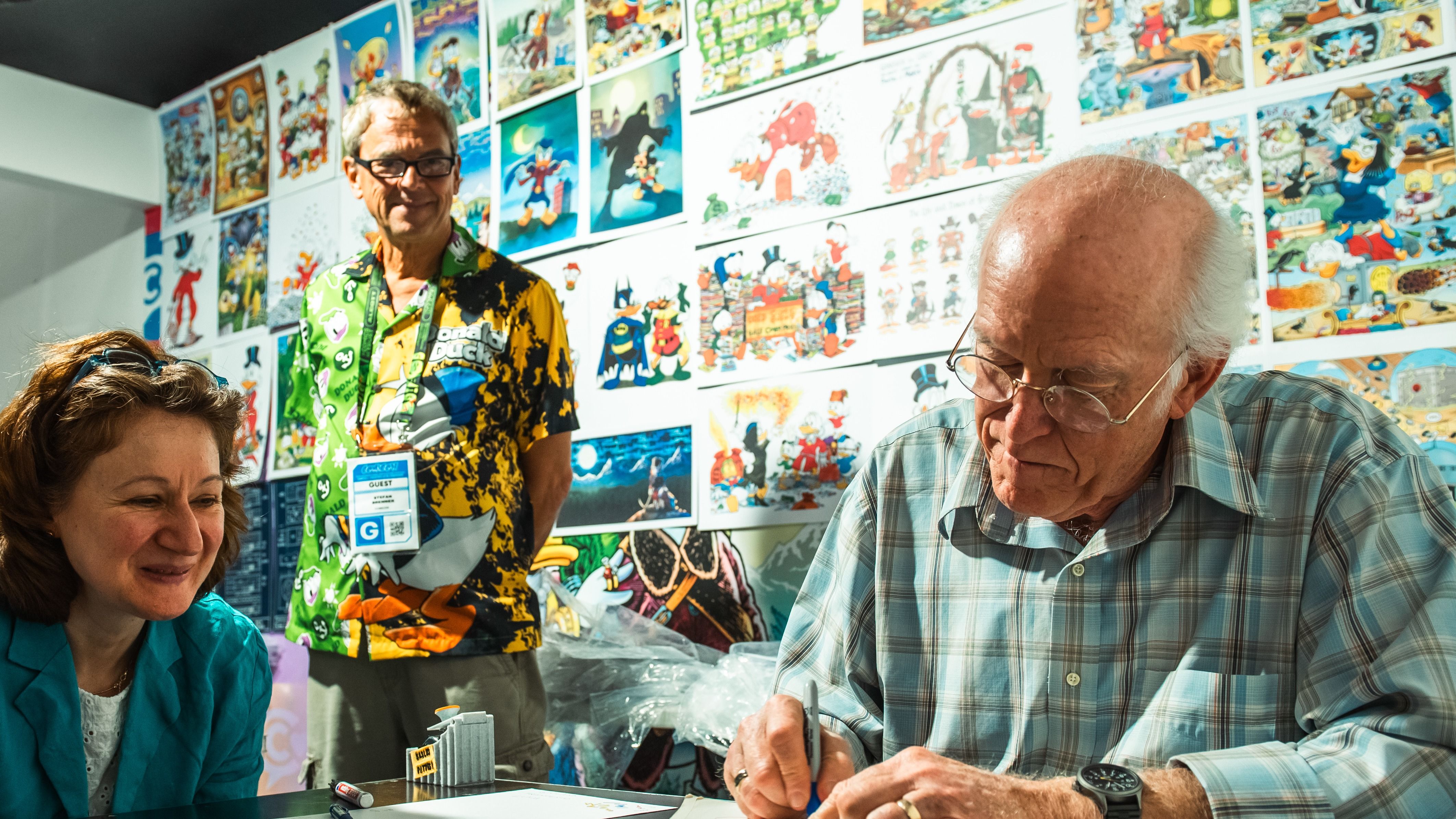
I just got back from Comicon Napoli 2026 in Italy – it was amazing! There were so many incredible people there, but a real highlight for me was meeting Don Rosa. He’s the comic book writer who really made Scrooge McDuck come alive for a whole generation, including me. While he didn’t create Scrooge or Donald Duck, he’s the one I instantly think of when I picture their adventures. He’s become a legend in the world of Duck comics, and it was a thrill to see him there!
Don Rosa continued the work of Carl Barks, the artist who created the Duck comics Rosa grew up admiring. Both artists are hugely responsible for the comics’ and characters’ enduring popularity. Rosa built on Barks’ foundation, significantly expanding the stories and bringing his own detailed, vibrant art style to a global audience. However, after decades of meeting fans at conventions around the world, Rosa has observed some concerning trends in how collectors behave, and he’s begun to share those observations.
At Comicon Napoli 2026, Ebaster had a unique chance to learn about Don Rosa, his comics, and his thoughts on the industry. This included a private interview with Rosa and a close-up view of his interactions with fans at his booth. Both experiences provided valuable insights into Rosa’s lasting influence and the current state of the comics world.
Don Rosa, Fan Conventions, And The Trouble With American Comics

I always found Rosa’s story fascinating. It’s not every day you meet a comic book writer who started out studying civil engineering! He actually grew up immersed in his family’s construction business, and for a long time, it seemed like that’s where he’d end up. But he made a really brave decision to walk away from that secure, potentially very profitable life. He told me he just wanted to pursue something he truly loved, and build a life based on passion, not just expectation or money. It’s a reminder that sometimes, the most rewarding path isn’t the most obvious one.
Don Rosa understood that creating comics wouldn’t make him rich, but he didn’t mind. He believed doing work you value is more important than simply earning a profit.
Rosa believes that decision profoundly impacted his life, his reputation, and the lives of his fans, though the experience varies for each person, he noted.
When I’m in America, I often find myself explaining who I am. Usually, I’ll meet someone every fifteen minutes or so who recognizes me, but many others mistakenly believe I voice Donald Duck in cartoons. Some even think I worked on the DuckTales TV show! It’s funny because they’ve never heard of the original Donald Duck comic books.
In Europe, Donald Duck comics are incredibly popular, often being read to children from a very young age – sometimes even from birth – because their parents enjoyed them as kids.
That type of impact, Rosa explained, is a deeply emotional, touching one, even decades on.
It’s incredibly humbling to know I’ve become a part of people’s lives from childhood, much like the artist Carl Barks was for me. After 35 years, I still struggle to understand all the attention. It’s hard to grasp that I could mean so much to others. In the US, someone recognizes me about every 15 minutes, but at conventions in Scandinavia and Central Europe, the response is overwhelming. As soon as the doors open, a line of around 250 people forms in just ten to fifteen minutes, and they have to close it for the day. Signing autographs for everyone would take ten hours straight! But I do sign for as long as I can because the energy from the fans gives me a real rush. It’s a bit cheesy to say, but I genuinely feel like I’m absorbing their energy, and the longer I do this, the more energized I become. It’s really moving.
Rosa stands out at conventions, both in the US and Europe. While most actors and artists charge fans for things like photos and autographs, Rosa offers everything – except for prints she sells – completely free.
Ebaster saw this happen firsthand when he joined Rosa at her booth at Comicon Napoli. Rosa had a constant flow of fans – something she said was normal at European conventions, but very different from what she usually experienced in America. She happily spent time with them, signing prints and taking free photos and selfies.
It was amazing seeing how much Don Rosa’s comics meant to people at these meet-and-greets! Kids and adults alike were telling him how the Duck stories shaped their childhoods, and it was so cool to hear some say they wanted to be comic artists themselves because of him. He was also incredibly thoughtful about his autographs. Each person would bring their favorite print, and Don would carefully pick out the perfect pen or marker color to make it look just right – he really took his time and cared about making each one special.
However, Rosa noted that his experiences in America often stand out. This isn’t about his practice of offering free sketches at conventions – he does that everywhere – but rather about what American comic book collectors are looking for and what motivates them.
As someone who grew up reading comics, it’s wild to think about how things have changed. I remember Uncle Scrooge comics flying off the shelves – we’re talking three million copies per issue! Now, even the best-selling Batman or Spider-Man titles are lucky to hit 100,000. It seems like comics in America aren’t what they used to be, though they did manage to stick around long enough to give us all those movies, TV shows, and toys we love. Interestingly, while the American market has shrunk, Duck comics – the kind I grew up with – are still huge in Europe, selling millions of copies. It’s a fascinating contrast, really.
Rosa pointed out the significant evolution of comic books in the United States over the past few decades and how this shift has altered what comics mean to many American collectors.
As a longtime observer of comic book culture, it really pains me to see what’s happened here in America. Everywhere else in the world, people collect comics because they love them – they read them, enjoy the stories, and appreciate the art form. But over the last two or three decades, Americans have been conditioned to treat comics solely as investments. It’s become common to see people buying issues, immediately sealing them away in plastic, and just…storing them. They’re not reading these things, they’re hoping to resell them for a profit later. Honestly, it’s heartbreaking to see a beloved hobby reduced to a financial transaction.
Rosa wanted to make it clear: he enjoys superheroes and their stories. His concerns don’t stem from the characters themselves.
I’ve always loved superheroes and collected American comics extensively, starting from World War II and continuing until around 1985. I eventually lost interest and sold most of my collection, keeping only comics up to 1970, which I consider the point when American comics started to decline in quality. I especially enjoy the older comics like Superman and early Marvel titles. While I adore Carl Barks’ characters – I see them more as people than ducks, having grown up with that perspective – I’m not a fan of the American comic book scene in general. It’s not that I dislike superheroes themselves, just the culture surrounding them.
Seeing how things were changing really made me understand why Rosa decided to retire after so many years doing what he loved. He’s always talked about how much Disney meant to him, and I think that played a big role in his decision too.
Rosa stopped working on comics 18 years ago because she noticed Disney increasingly trying to control them, which she felt was inappropriate since those stories weren’t originally Disney properties. Specifically, she pointed out that Disney had no prior involvement with characters like Scrooge McDuck, whose creation was entirely due to Carl Barks.
More than anything, Rosa wants people to understand he cares most about connecting with fans. He isn’t focused on Disney itself, or what might happen with these stories in the future. What truly matters to him is meeting the people who enjoy his work and the work of Carl Barks – whether it’s at large European comic conventions or with small groups of dedicated Duck comics fans here in the United States.
Read More
- Биткойн падает после громких заявлений из Белого Дома о криптовалюте и Федеральной Резервной Системы, сохраняющей спокойствие.
- The True Story That Inspired Abbott Elementary’s Choice To Move The School Into A Mall
- Inception Meets Lost In HBO’s 4-Part Sci-Fi Game Of Thrones Replacement
- Every Jack Ryan Movie, Ranked
- Циан акции прогноз. Цена акций CNRU
- Viggo Mortensen ‘Thrilled’ With Jamie Dornan’s Aragorn Recasting
- Star Trek: Starfleet Academy Review – The Kids Are Just Okay in Gaia Violo’s School-Set Comedy-Drama
- Доллар обгонит южноафриканский рэнд? Эксперты раскрыли неожиданный сценарий
- Доллар обгонит аргентинское песо? Эксперты раскрыли неожиданный сценарий
- Seth Rogen’s Knocked Up Becomes a Global Streaming Hit on Netflix
2026-05-07 18:44