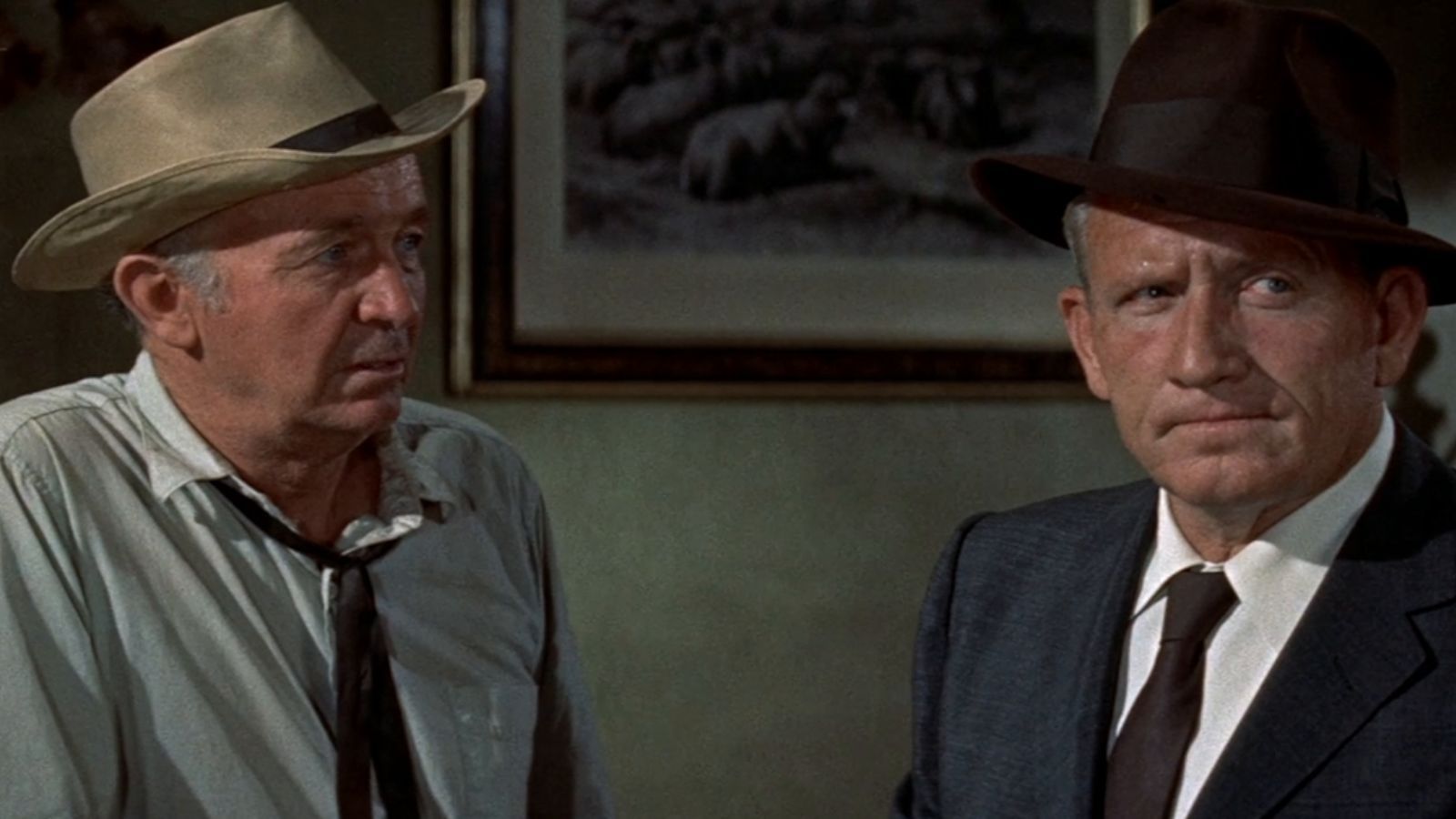
The Western genre has thrived when it’s been reimagined for new audiences, resulting in critically acclaimed films like No Country for Old Men and Unforgiven. The enduring appeal of the Old West continues to inspire creators such as Taylor Sheridan, who have built successful franchises like Yellowstone. While modern Westerns are popular, a standout film from the Cold War era, Bad Day at Black Rock, remains a particularly compelling and suspenseful mystery.
The years following World War II were a complex time in American history, and how people remember it has changed over time. Some see it as a period of great success, with a booming economy and a growing middle class. Others remember it as a time marked by prejudice, the fight for civil rights, and fear fueled by the Cold War rivalry between the US and Russia. In 1955, director John Sturges captured some of this national unease in a compelling thriller that reflected the challenges America faced after the war.
Bad Day at Black Rock is a Tense Mystery
The film Bad Day at Black Rock begins with a train arriving at the isolated town of Black Rock. When the train stops, a man named John J. Macreedy, who has only one arm, gets off. The conductor wishes him well, noting that this is the first train stop in Black Rock in four years.
When a stranger arrives, the townspeople quickly become curious, then suspicious. Macreedy is met with either cold silence or veiled threats, making it clear he’s not welcome, particularly by some of the more dominant locals. His inquiries about a farmer named Komoko, who happens to be Japanese-American, escalate the tension, especially when he learns the man has died.
When Macreedy asked for directions to Komoko’s house on Adobe Flat, the situation quickly turned dangerous, with one man attempting to force him off the road. Macreedy barely escaped, skillfully maneuvering his vehicle, and returned to town determined to continue his search. He discovered Komoko’s home had been burned down, with only wildflowers remaining – a clear sign Komoko was likely dead. Though locals claimed Komoko had been sent to a Japanese internment camp during the war, Macreedy found evidence suggesting otherwise.
As Macreedy spends more time in town, he begins to understand the people who live there. He learns that Reno Smith, despite appearing calm, secretly resents Komoko and feels insecure about being denied military service. Reno relies on the intimidating Hector David and Coley Trimble to control the town. Sheriff Tim Horn, struggling with alcohol, knows what’s been happening but avoids getting involved, and Doc Velie, an older resident, tries to dissuade Macreedy, fearing retaliation if he gets too close.
Bad Day at Black Rock Explores Wartime Xenophobia
When John J. Macreedy arrives in Black Rock, old secrets resurface and split the town apart, forcing everyone to confront their own morals. Those who committed the original wrongdoing will stop at nothing to keep it hidden, while others struggle with what they should do. Any attempt to help Macreedy escape or find Komoko is quickly thwarted by Reno or one of his men.
The truth exposes a surge of anti-Japanese sentiment following the attack on Pearl Harbor. Fueled by anger over the attack, Reno attempted to join the military but was rejected. Returning home, he and his friends, consumed by rage and alcohol, targeted Komoko, a Japanese man, and burned his home with him inside. When Komoko tried to escape, Reno shot and killed him, and his friends assisted in burying the body and concealing the crime. Believing Komoko had no family who would seek justice, they thought they could get away with it – until Macreedy arrived and began investigating.
War often brings unfair blame and suspicion, and the film Bad Day at Black Rock powerfully illustrates how destructive this can be. Macreedy isn’t investigating anything; he’s simply traveling to deliver a war medal to Komoko’s father, recognizing his son’s heroic sacrifice in Italy – he saved Macreedy’s life. It’s suggested Macreedy intended to end his own life after completing this final act of respect. Reno’s animosity is completely unfounded; he isn’t motivated by patriotism, but by a desire to blame someone else for his own failures.
The Film Doubles as a Crime Thriller and a Revisionist Western
Beyond just being a typical murder mystery, Bad Day at Black Rock also offers a look at the themes of the Western genre. The town in the film feels separate from modern America, existing almost on its own. Characters like Reno Smith and Hector David desperately try to maintain their way of life, holding onto the idea of the Old West.
It’s strange – except for the cars, Black Rock feels like stepping back into the 1880s. Everything, from the old-style bars to the clothes people wear, feels so old-fashioned. When outsiders like Macreedy arrive, or even someone different like Komoko, it really shakes things up. It’s like a reminder that they’re clinging to a past that’s gone, and that the world is moving on without them. It feels like they don’t want to be part of the present, and these newcomers threaten their way of life.
The film powerfully captures the major flaws of 20th-century America all at once. Issues like wartime prejudice, the desire to stay out of foreign conflicts in the 1930s, Cold War anxieties, and the fear created by McCarthyism all haunt the town of Black Rock. This small town represents everything that held the nation back, and it takes only an outsider, Macreedy, simply trying to do something kind, to expose these deep-seated problems. Even a little investigation reveals the town’s foundation is built on lies.
The film often explores similar ideas to other movies made around the same time, particularly the question of what happens when people stay silent during injustice and how that silence affects them. It shows that even a little bit of questioning, like what Macreedy does in just one day, can help people rediscover their morals, though not without significant consequences. Even those who ultimately do the right thing, such as Pete Wirth, still suffer deeply for their choices.
Bad Day at Black Rock Has Aged Brilliantly
Though made decades ago, Bad Day at Black Rock remains surprisingly relevant, especially now as distrust of outsiders is growing again. The film’s themes of division and dehumanization – the same forces that led to tragedy for its protagonist – are sadly echoing in today’s increasingly polarized political and social climate. Released shortly after World War II and the controversial internment of Japanese Americans, the film powerfully explores how easily ‘us versus them’ thinking can take hold, particularly in struggling communities like the one depicted.
Similar to many allegorical stories, the town of Black Rock isn’t meant to be taken literally. It represents the United States and its struggles, with each character embodying a different societal problem. The film powerfully addresses issues like racism, indifference, and the connection between poverty and hatred. It’s a strong political statement reflecting the anxieties of the Cold War era and a criticism of the fear-mongering associated with McCarthyism.
Despite its short runtime of just eighty-one minutes, the film delivers a powerful message and serves as an important reflection of its era. Even seventy-one years later, John Sturges’ Bad Day at Black Rock remains a compelling Western mystery, and its themes feel surprisingly current today.
Read More
- ‘YouTube Customers Are Suffering.’ Disney CFO Says Company Isn’t Backing Down As Cable Outage Continues
- 2026 Oscar Contenders: Where to Stream Sinners, Bugonia, Jay Kelly
- Hamnet’s Jessie Buckley Reacted To Paul Mescal’s Oscars Snub
- Доллар обгонит рубль? Эксперты раскрыли неожиданный сценарий
- Michael C. Hall’s ‘Safe’ Is Perfect for ‘Dexter’ Fans
- Filings Reveal Trump Bought Part of Netflix’s Debt — What Does That Actually Mean?
- 3 Top Movies To Stream On Netflix This Week (October 20-24)
- Евро обгонит тайский бат? Эксперты раскрыли неожиданный сценарий
- With Frank Grillo Confirmed For Man Of Tomorrow, I Hope It Means The Next Superman Movie Will Include A Specific Peacemaker Crossover
- Pluribus: Why Helen Died May Actually Be Because of Carol
2026-01-25 22:38