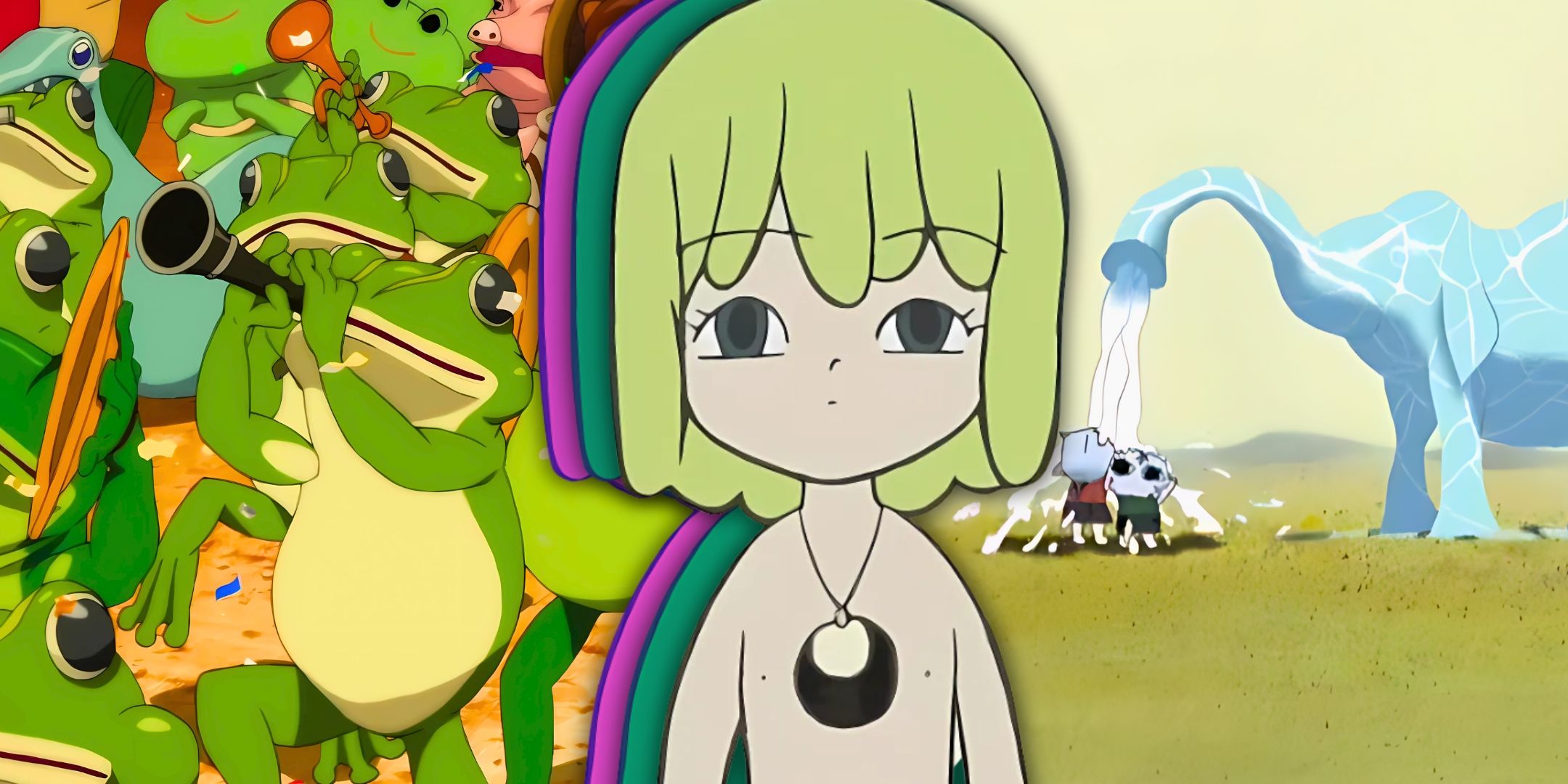
What draws many people to anime is its incredible creativity. Anime stories frequently start with original and captivating ideas, then build those ideas into complex and meaningful narratives. These shows are often called “high concept” because they have a clear, interesting premise that immediately stands out.
I’ve noticed that a lot of really interesting anime can be explained with just one sentence, but that doesn’t mean they’re shallow. These shows, the ones with truly original ideas, are incredibly creative and offer a lot more than just a cool premise. What’s amazing is that they don’t get old—every time I rewatch them, I discover new things to appreciate. They really hold up over time.
Ghost in the Shell Dives Deep into a Dystopia Where Technology Has Merged with Humanity
Science fiction often explores big ideas, and the Ghost in the Shell franchise does this exceptionally well. It’s set in a future where technology is so advanced that it’s hard to tell the difference between humans and machines.
As technology has advanced, so has cybercrime, putting pressure on Public Security Section 9 and its leader, Major Motoko Kusanagi, to keep up. But Ghost in the Shell isn’t just about a futuristic idea; it consistently explores complex themes in new and interesting ways, offering viewers something new to think about with each viewing.
Psycho-Pass Examines Justice in a Highly Authoritarian Sci-Fi World
I recently watched Psycho-Pass, and it’s another one of those sci-fi stories that imagines a dark future. What’s interesting is that, for many people within that future, it actually appears to be a perfect world. They’ve developed this incredibly advanced system, called the Sibyl System, that can analyze everyone’s mental state and even predict if they might commit a crime.
To stop potential criminals before they act, Inspectors suppress anyone who threatens the established order. Though it begins as a cyberpunk police story, Psycho-Pass uses its intriguing setup to explore complex questions about justice and free will, presenting moral dilemmas and leaving viewers to decide for themselves what is right.
The Tatami Galaxy Makes the Potential Regrets of Its Hero Manifest in Reality
I think everyone’s wondered at some point what life would be like if they could go back and change things. That feeling is made incredibly real in the anime The Tatami Galaxy. It follows a nameless student who keeps reliving his college years, desperately trying to find that perfect, idealized college experience – a ‘rose-colored campus life’ that always seems just out of reach.
The Tatami Galaxy is a unique and experimental anime. Each alternate storyline is full of bizarre and unexpected events. The animation style is equally captivating and unusual, typical of director Masaaki Yuasa’s work. It’s a surreal and quick-paced series that can be challenging to fully understand on a first viewing, but it remains endlessly rewatchable.
Kaiba Takes Place in a Universe Where Identities Are Stored as Information
Masaaki Yuasa is known for creating complex and imaginative stories, and his 2008 anime, Kaiba, is a great example. The series starts with a compelling idea and develops into a deeply meaningful and thought-provoking experience. In the world of Kaiba, memories become something physical, able to be saved on chips even after someone dies.
The main character of Kaiba wakes up with no memory of who he is, only a strange hole in his chest and a pendant containing a picture of a girl. This marks the start of his quest to figure out his identity, a journey that explores big ideas about memory, what it means to be aware, and the nature of death. Though it’s a short, complete story, Kaiba is remarkably layered and offers new things to think about with each viewing.
Paprika Blurs the Line Between Reality & Dream
I’m a huge fan of Satoshi Kon, and what I love about his work is how he always tackles these really mind-bending, ambitious stories. He’s a master of psychological thrillers, and a lot of his films play with what’s real and what isn’t. Paprika is a perfect example – it’s got this amazing premise centered around a device called the DC Mini. It’s basically a machine that lets you enter other people’s dreams, and it was originally created to help doctors with therapy. It’s such a cool concept!
The DC Mini, while intended to be helpful, becomes a dangerous weapon when misused, capable of manipulating people’s minds. The movie Paprika has a simple, immediately engaging concept. However, like most films by Satoshi Kon, it’s complex and layered, rewarding repeated viewings as you explore its fascinating dream worlds.
Link Click Is a Completely Novel Take on a Classic Sci-Fi Premise
Everyone’s seen time travel stories, and honestly, a lot of them feel pretty similar these days. But I have to say, Link Click does something really different with the concept. It takes this familiar idea and approaches it in a way I haven’t seen before.
Lu Guang and Cheng Xiaoshi run Time Photo Studio, but they have a secret: they can enter any photograph and fix their clients’ past mistakes in the present. However, they have a strict rule: they can’t actually change the past, which proves challenging for time travelers. Initially appearing as a simple case-of-the-week series, Link Click evolves into a complex and thrilling supernatural mystery that truly pays off for attentive viewers.
Serial Experiments Lain’s High Concept Develops Into a Convoluted Meditation on Reality & Technology
Serial Experiments Lain was remarkably prescient. The series follows Lain Iwakura, a withdrawn girl who becomes fascinated by ‘The Wired,’ a strange virtual world. It delves into the blurring lines between reality and the digital realm, and its themes feel surprisingly current in today’s social media landscape, even more so than when it first aired in the 1990s.
Unlike many anime that focus on a strong plot, Serial Experiments Lain prioritizes exploring complex ideas over telling a straightforward story. This unique and experimental approach actually makes the series more captivating and offers new insights even after multiple viewings.
Fate/Zero Sees Mages & Legendary Heroes Fight to the Death in a Ruthless Battle Royale
The Fate series centers around the exciting idea of the Holy Grail War – a fierce competition where mages team up with powerful heroes from the past to fight for a wish-granting treasure. Fate/Zero is a great introduction to this conflict, showing why the Holy Grail War is so captivating, and offering a visually stunning fantasy experience.
Fate/Zero is more than just visually stunning action; it’s a battle of ideas. Each character wants the Holy Grail for deeply personal and complicated reasons. What sets it apart from other action shows is that it remains interesting even after you know how the story ends, and it doesn’t lose its impact on repeat viewings.
FLCL Is a Brilliant Mix of Chaotic Ideas Explored Within an Intimate Coming-of-Age Story
I have to say, the premise of FLCL is unlike anything I’ve seen in anime. It really starts when this normal teenager, Naota, gets smacked on the head by an alien on a Vespa, and then a robot literally pops out of his head! The whole six-episode series is just packed with these incredibly strange ideas, and honestly, it doesn’t seem to worry much about whether you actually understand what’s going on.
There’s something incredibly captivating about the wild energy of FLCL, even if it takes multiple viewings to fully understand what’s going on. The show doesn’t present its ideas directly, but if the story connects with you emotionally the first time, you’ll likely find yourself wanting to dig deeper and uncover its many layers.
Death Note’s Intriguing Premise Is Known to Every Anime Fan
I always thought Death Note was a perfect example of an anime that takes a really interesting idea and builds something truly special with it. The premise is simple: a student discovers a notebook that lets him kill people just by writing their names. Honestly, it’s hard to imagine a more captivating starting point for a story, and it really delivers on suspense and twists.
The enduring popularity of Death Note isn’t simply due to its interesting concept. What truly sets it apart is how the story unfolds through the eyes of both the killer and the detective trying to stop him, with a strong focus on the characters’ inner lives. Many of the story’s clever hints and subtle details become more noticeable and enjoyable on repeat viewings, after the initial emotional impact has faded.
Found an error? Send it so it can be corrected.
Title
—Clues
—
2026-03-22 19:05