
This scene is iconic in film history. Luke Skywalker travels to Cloud City to face Darth Vader, and a long and intense lightsaber duel begins. Vader ultimately overpowers Luke, trapping him on a platform high above a bottomless pit.
Just when everything seems hopeless, a young girl wearing overalls unexpectedly shows up, defeats Darth Vader in a lightsaber battle, saves Luke, and brings peace back to the galaxy.
Does the ending of The Empire Strikes Back seem a little different than you recall? That’s because an alternate version of the climax actually appeared in a bizarre, forgotten stage show called George Lucas’ Super Live Adventure from 1993. This production was one of the strangest of the 20th century, blending storylines from all of Lucas’ major films – including Star Wars, Indiana Jones, Willow, American Graffiti, and even Tucker: The Man and His Dream – into one big story.
In the early 1990s, Lucasfilm wanted to mark its 20th anniversary with a special show. They reached out to Kenneth Feld, a well-known theatrical producer who at the time was running popular events like Ringling Bros. and Barnum & Bailey Circus, Disney on Ice, and Monster Jam, to bring their idea to life.
The show was originally intended to debut in Japan. Star Wars had a large following there, and George Lucas was also quite famous due to his appearances in a series of Japanese commercials for Panasonic. (If you’re curious, you can find these surprisingly entertaining commercials on YouTube.)
It was clear George Lucas wouldn’t actually be in the big, action-packed stage show, but he did allow them to use his name and content from most of his films as a director or producer. The one exception? His movie Howard the Duck didn’t make the cut.
I spoke with production designer Douglas Schmidt a few years back, and he explained the core idea behind Super Live Adventure. It was all about creating a massive, arena-style show that pulled storylines from all of George Lucas’ films and blended them into one huge, spectacular event. Basically, imagine everything you love about those movies, live and on a grand scale!
He wasn’t exaggerating – the Super Live Adventure was truly enormous. TheRaider.net reports the stage was wider than a quarter of an acre and as tall as a five-story building. The production involved a team of over 150 people, 76 custom speakers, a musical score performed by 140 musicians, and a dazzling display of over 1,000 laser beams fired from 23 different points during the show.
The show was packed with incredible sights! There was a massive castle complete with a functioning drawbridge, and a giant inflatable jukebox modeled after the one from the movie American Graffiti. A nearly ten-minute musical performance featured a self-driving vintage car, inspired by the film Tucker. They even recreated the famous melting face scene from Raiders of the Lost Ark, and there was at least one onstage beheading. To top it all off, a huge Millennium Falcon descended from the ceiling and landed right on the stage!
Also there was a live horse and a live Bengal tiger for some reason?
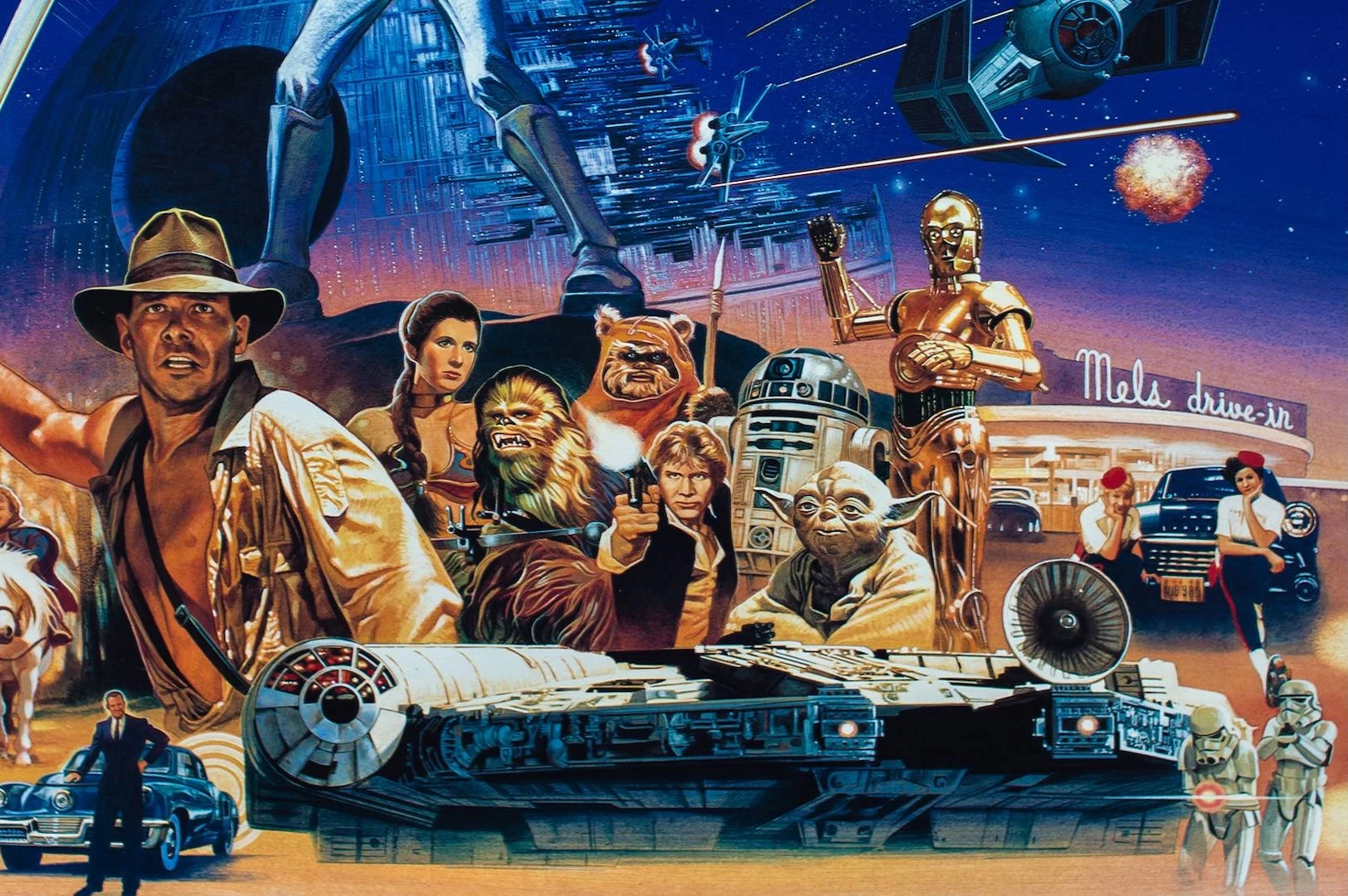
The basic idea behind George Lucas’ Super Live Adventure is pretty unusual: Willow, the character from the movie Willow, picks someone from the audience – actually a hidden plant – to assist him on a mission. This ‘audience member’ receives a magic wand and is then chased through scenes from various George Lucas films, appearing in a seemingly random order.
Okay, so imagine this: after barely escaping a fantasy world, this girl suddenly finds herself at a Preston Tucker car show! Then, things get crazy – giant snakes attack, and thankfully, Indiana Jones shows up to save her. (Seriously, why does it always have to be snakes?!). Indy then takes her on this incredible recreation of the rope bridge fight from Temple of Doom, and then they end up at Club Obi-Wan, which perfectly captures the wild energy of that whole movie. After that, it’s like they’re jumping right into Raiders of the Lost Ark – bits and pieces of the movie just appear around them. Finally, she winds up in sections dedicated to American Graffiti and Star Wars. It’s a total whirlwind of classic movie moments!
The production designer revealed that George Lucas’ Super Live Adventure needed almost two months of rehearsals in an empty arena. Despite all the preparation, the show only ran for one summer in Japan. Surprisingly, there wasn’t much interest in a production that mixed the exciting action of Star Wars with a thoughtful commentary on capitalism, as delivered by Tucker. After running from April to September 1993, the show was discontinued.
For years, fans have shared blurry, low-quality recordings of the Super Live Adventure online. Recently, though, a remarkably complete version surfaced – over 100 minutes long with only one noticeable edit. What’s especially impressive is the camera angle: positioned directly in front of the orchestra, it offers a fantastic view of the entire performance, allowing you to fully appreciate the scale of the production and the detailed choreography of the fights and dances.
The video is in Japanese and doesn’t have subtitles, but you can still generally follow what’s going on. It’s a bizarre and fascinating stage show, like a mashup of the worlds of Willow and Raiders of the Lost Ark, and it’s as confusingly wonderful as you’d expect.
See for yourself below.
The most frustrating moment was at the end of the show, when a young girl received a medal from Admiral Ackbar. It was surprising because Chewbacca didn’t get one, but someone from the audience did?! I understand she beat a Sith Lord, but it still seems a bit strange.
Lucas didn’t seem to be heavily involved in making Super Live Adventure; he mostly just allowed the use of his name and characters. However, the show – featuring Luke Skywalker, Han Solo, Indiana Jones, Willow, and a character from American Graffiti – feels like a peek inside George Lucas’ imagination, albeit a rather chaotic one – like what you’d get if he was sick with a fever.
It’s fantastic to have such a complete version of this film, but I’m still hoping for more. I’d love to see it with subtitles so I can really follow the story, especially the incredible moment when the character goes from watching a play in Japan to battling Darth Vader with a lightsaber. A high-definition version would be amazing to fully appreciate the stunts and special effects, and I’m really hoping George Lucas will release a director’s commentary where he can share his honest thoughts about how it all came together.
I just realized something amazing: George Lucas is opening a museum in Los Angeles all about the art of storytelling! And honestly? Everything he’s created deserves to be there – especially that iconic saga he built. It feels so right!
More on the History of George Lucas’ Super Live Adventure:
Movies You Never Realized Were Produced by George Lucas

Kagemusha (1980)
As a huge movie fan, I’ve always known George Lucas admired Akira Kurosawa, and it’s fascinating how much Star Wars owes to those classic samurai films, especially The Hidden Fortress. But what really blew me away was learning that Lucas actually helped Kurosawa finish his film Kagemusha! Apparently, production ran into financial trouble, and Lucas stepped in as an executive producer, using his success to secure the funding needed to complete it. It’s a wonderful example of one artist paying tribute to, and supporting, another.

Body Heat (1981)
As a critic, I’ve always been fascinated by the collaborations that shape iconic films, and the one between George Lucas and Lawrence Kasdan is a prime example. They really hit their stride in the early ’80s, teaming up to write blockbusters like The Empire Strikes Back and Raiders of the Lost Ark. But their relationship went deeper than just writing. When Kasdan stepped into the director’s chair for his debut, the steamy thriller Body Heat, Lucas quietly supported him as an uncredited executive producer. What’s really interesting is why Lucas stayed behind the scenes. He admitted he didn’t want the focus to shift to him making a more adult, erotic film. He wanted all the attention on Kasdan and his vision, fearing that a ‘George Lucas production’ label would overshadow the movie itself. It’s a surprisingly selfless move, and speaks volumes about Lucas’ understanding of how perception works in Hollywood.

Twice Upon a Time (1983)
This film, produced by Lucasfilm, marked George Lucas’s first venture into animated movies. He initially invested in the project and played a key role in getting it funded through the Ladd Company, led by Alan Ladd – the same executive who had financed the original Star Wars. Despite limited releases on home video over the years, the unusual animated film is now available on DVD through the Warner Archive.

Latino (1985)
Lucas also produced a 1985 film directed by Haskell Wexler, called Medium Cool, which focused on the conflict in Nicaragua. It premiered at the Cannes Film Festival in 1985, and, like with Body Heat, Lucas kept his name off the credits, likely for similar reasons.

Mishima: A Life in Four Chapters (1985)
George Lucas and his company, Lucasfilm, also helped produce Paul Schrader’s complex film about Yukio Mishima. Unlike some of his other projects, Lucas wasn’t just an executive producer; he actively promoted the movie, even allowing his name to appear prominently on posters as one of the film’s presenters. (We’ll explain who the other presenter was shortly.)

Labyrinth (1986)
The movie Labyrinth is remembered as Jim Henson’s last directorial effort, and its ambitious fantasy world wasn’t immediately embraced by critics or viewers. It wasn’t the typical Muppet film fans were used to. Although Henson directed, Lucasfilm was also involved – George Lucas served as an executive producer and reportedly contributed to the script and editing, though without receiving official credit.

Howard the Duck (1986)
Surprisingly, the first Marvel comic book adapted for the big screen wasn’t Spider-Man or the Fantastic Four. It was 1986’s Howard the Duck, based on the quirky character created by Steve Gerber and Val Mayerik. Despite George Lucas’s role as a producer and the use of impressive special effects for the time, the movie failed to attract audiences and became a notorious flop. Even today, it’s often considered the strangest Marvel film ever made.

Captain EO (1986)
When Disney decided to create a 3D film featuring Michael Jackson, they partnered with George Lucas and Lucasfilm for production. Lucas co-wrote the script for Captain EO, a story about a space explorer who dances his way through a galaxy reminiscent of Star Wars. The film was directed by Francis Ford Coppola, a mentor and friend of Lucas – marking the first time Coppola directed a script Lucas had helped write. Captain EO played at Disney parks for twelve years and was re-released after Jackson’s death in 2009 as a tribute. This collaboration also launched a lasting relationship between Lucas and Disney’s parks, eventually leading to Star Wars and *Indiana Jonesthemed rides.

Tucker: The Man and His Dream (1988)
After a string of unsuccessful films in the 1980s left Francis Ford Coppola in financial difficulty, George Lucas stepped in to help. He became an executive producer on Coppola’s film, Tucker: The Man and His Dream, which starred Jeff Bridges as Preston Tucker, a determined inventor who tried to challenge the established car industry but was ultimately overwhelmed by wealthier competitors. Both Coppola and Lucas likely identified with Tucker’s struggle, given their own experiences in Hollywood.

Radioland Murders (1994)
This George Lucas film is largely forgotten today. Lucas both produced and wrote the story for this 1930s-set screwball comedy, which centers around a mystery at a radio station. Starring Mary Stuart Masterson and Brian Benben of Dream On, the film was a major box office disappointment, earning less than $1.5 million.

Red Tails (2012)
Before George Lucas sold Lucasfilm to Disney, he produced Red Tails, a film about the Tuskegee Airmen, the first Lucasfilm movie since Radioland Murders that wasn’t connected to Star Wars or Indiana Jones. Lucas had been working on this project for almost thirty years, initially envisioning a series of three large-scale war movies. However, when Red Tails was finally released, it was a standalone story that Lucas primarily funded himself, as he had difficulty securing studio support.

Strange Magic (2015)
Lucas’s latest project, aside from his role as executive producer on Indiana Jones and the Dial of Destiny, is a peculiar animated film. He originally envisioned it as a female-led story similar to Star Wars—a fantasy musical about a fairy princess who falls in love with a bog king in a magical forest. Like Red Tails, Lucas was deeply passionate about Strange Magic and dedicated over a decade to its development, both before and after selling Lucasfilm to Disney, who eventually released it.
Calling the finished film “strange” is fitting, given its unusual character designs and a soundtrack reminiscent of American Graffiti, featuring popular songs from the past. Unfortunately, it was a significant box office failure, earning back only a small portion of its reported $100 million budget.
2026-02-13 21:29