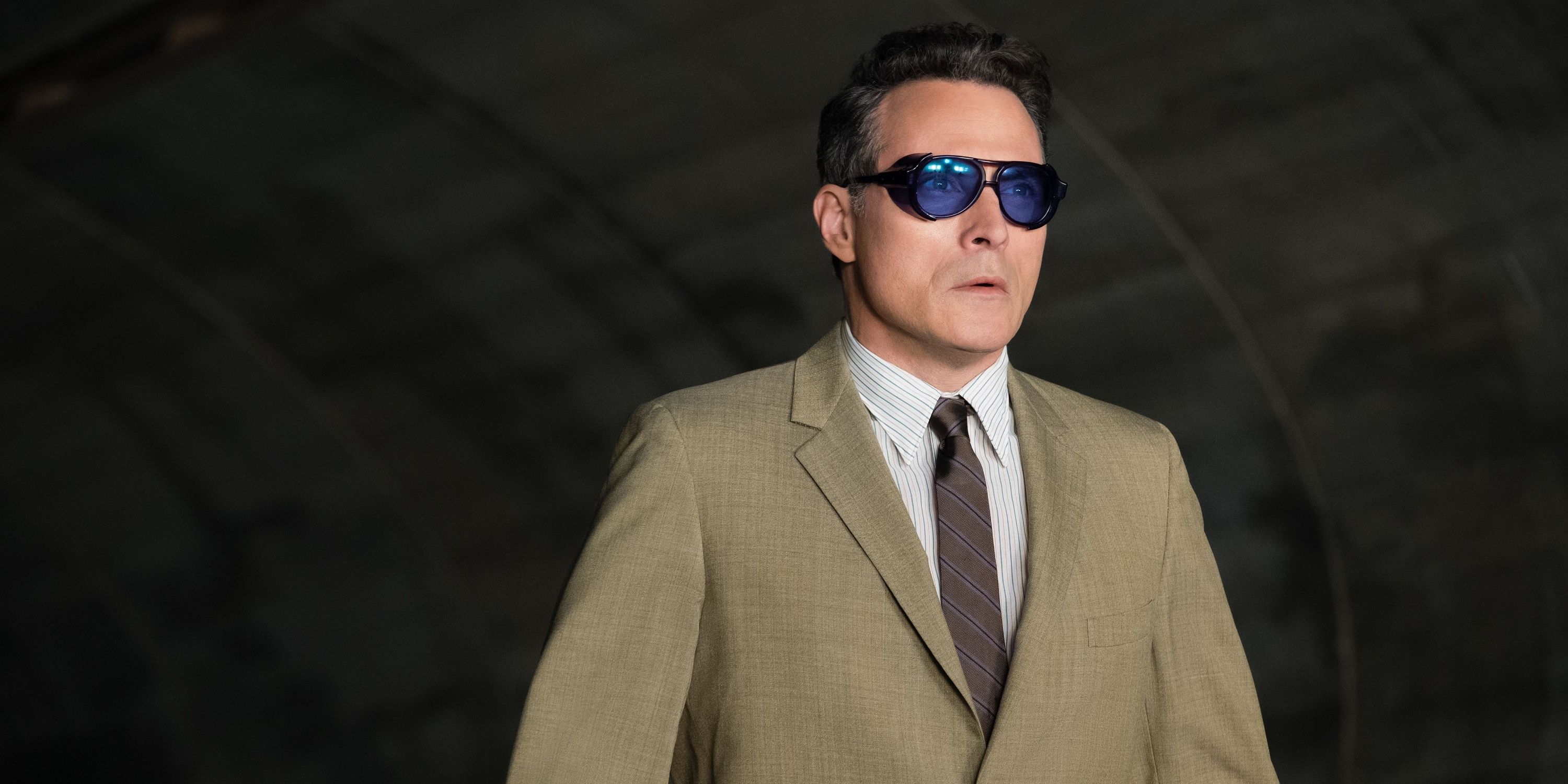
Renowned filmmaker Ridley Scott has expanded into television, with his company producing popular and critically acclaimed shows like The Good Wife, Raised by Wolves, and the recent Alien: Earth. He was also an executive producer on The Man in the High Castle, an adaptation of Philip K. Dick’s 1962 novel of the same name. The series quickly became a hit and ran for four seasons.
As a huge cinema and TV fan, I think the critical consensus on this show – that it’s ‘unlike anything else on TV’ – is spot on. It really nails this incredibly detailed and unsettling post-WWII world. Honestly, few stories have ever managed to create such a powerfully suffocating atmosphere of dread, and this one definitely does. Even though the ending was a little open to interpretation, it’s a show that consistently delivers a real emotional impact. It sticks with you, you know?
The Man in the High Castle Reframed WWII into an Endless Nightmare
The TV series The Man in the High Castle mirrored the novel’s reimagining of world politics. The story is set in 1962, but in an alternate reality where history changed after the successful assassination of President Franklin D. Roosevelt. In our world, Roosevelt survived an assassination attempt in 1933, but in this alternate timeline, his death dramatically altered the course of history.
Franklin D. Roosevelt won four presidential elections and led the United States during much of World War II. However, if he hadn’t been president, the war would have unfolded very differently. Without US involvement, Nazi Germany crippled the country by launching a nuclear attack on Washington, D.C. This paved the way for a Japanese invasion of the West Coast and ultimately, America’s surrender.
One early installment of the series clearly showed the suffering of different minority groups, exposing the existence of concentration camps built throughout the country. This horrific practice continued for decades, representing a seemingly endless extension of one of history’s worst atrocities. Within the expanded Nazi Reich – which now encompassed most of Europe, large parts of the United States, and sections of North Africa – slavery and eugenics were revived.
The American Reich, based in New York City, is surprisingly advanced for the year 1962. Thanks to German scientific breakthroughs, they have technologies like supersonic planes, video calls, and widespread surveillance cameras. Everyone is expected to contribute to society, and those unable to do so – even due to illness or disability – are euthanized, without regard for their background or beliefs.
In this alternate history, Japan conquered the western coast of North America, a region already marked by discrimination against those not of Japanese descent. Now called the Japanese Pacific States, the area was governed from San Francisco – a city with a poignant historical connection, as it once housed an internment camp for Japanese-Americans. The Empire established a strict social hierarchy within the Japanese Pacific States, creating a brutal and oppressive reality that, while different, felt disturbingly familiar.
Along the Rocky Mountains lies an area known as the Neutral Zone. Several states within it were largely left to govern themselves, becoming somewhat unstable as a result. The Neutral Zone offered a brief escape from strict, harsh rule and felt similar to how things used to be. However, changing relationships between powerful nations put the Neutral Zone at risk, potentially turning it into a dangerous conflict area.
As a movie buff, I’ve always noticed a pattern in how we portray WWII. It really set the stage for America becoming a dominant world power. While Asia and Europe were basically flattened, the US economy boomed, we developed nuclear weapons, and our influence spread everywhere. The old empires? They just crumbled. And honestly, most of us Americans – especially those of us who grew up in the mid-20th and 21st centuries – have never had to experience war on our own soil, which shapes how we see these events.
Stories that rewrite history often lean towards hopeful outcomes, like in shows such as For All Mankind and films like Inglourious Basterds. However, some take a darker turn, as seen in The Man in the High Castle, where Hitler survives and the Nazis control much of the world. This series depicts a drastically altered America – a distorted reflection of its ideals, symbolized by the destruction of the Statue of Liberty in Season 3, representing the loss of the nation’s identity and values.
The show felt completely disconnected from reality, like a strange and disturbing dream you couldn’t wait to escape. Thankfully, The Man in the High Castle offered a way to do just that.
The Titular Man in the High Castle Offers Glimpses of Impossible Hope
In the series The Man in the High Castle, the title refers to a person secretly fighting against both the American and Japanese powers controlling the country. At first, this figure is presented as an enigmatic legend, but the beginning of Season 2 reveals him to be Hawthorne Abendsen.
If he hadn’t intervened, things would have stayed the same – a fragile balance between Germany and Japan. The story wouldn’t have happened, because any attempt to fight against their powerful, well-organized forces would probably have failed. Even those who were determined to rebel would likely have lost hope over time.
Abendsen’s film collection proved that alternate universes existed, and this discovery dramatically accelerated the story. The knowledge of other worlds – worlds that often mirrored our own – gave the resistance a powerful new hope. When Juliana Crain saw the first film, it profoundly changed her, launching her on a complex and challenging journey.
I’m really fascinated by this collection of films, called The Grasshopper Lies Heavy. The title itself is a cool reference to the Bible! It shows us events that didn’t actually happen in the show’s world, but feel like they could have. It covers everything from what Berlin might have been like when it fell, to fake Soviet propaganda and how WWII leaders might have been portrayed. But it doesn’t stop there – it also gives us glimpses of things that did happen, like Martin Luther King Jr.’s famous speech and the Vietnam War. And it hints at a really bleak future, suggesting a Third World War devastated the planet. It’s a really thought-provoking mix of history and what-ifs.
Although what’s happening now is most important, our understanding of events is always influenced by both history and our hopes for what’s to come. That’s why films about current events are so powerful. They showcase characters – like Juliana Craine, Joe Blake, Frank Frink, George Dixon, and Thomas Smith – who are thrust into situations no one could have predicted for them.
For a long time, it was a mystery how the films came to be, but the first season finale offered a small clue. Nobusuke Tagomi, a trade minister from the Japanese Pacific States, finds himself in a world where the United States is the dominant power. Later episodes revealed that certain individuals could travel between realities using unexplained meditation techniques.
The Man in the High Castle Concluded on a Meaningfully Ambiguous Note
It’s hard to imagine a peaceful resolution for the world, as many envision a future filled with conflict. However, The Man in the High Castle presented a different scenario, where tension simmered beneath the surface of each superpower’s control. The declining health of Hitler was always likely to trigger a power struggle, ultimately leading to war. At the same time, Imperial Japan tried to make up for its weaker military by heavily controlling the areas it occupied.
I’ve been thinking about the opening and closing lines of Season 1 of this show, and they really struck me. Tagomi starts us off with “Destiny in the hands of men,” which feels hopeful, but then Hitler twists it at the end to “Destiny is in the hands of very few men.” It’s subtle, but it highlights a key idea: the actions of a small group of people are going to decide everything. It really emphasizes how important each character’s choices are to the outcome of the story.
Some characters, including Tagomi and Juliana, learned to travel to different realities through meditation, drawing on principles from Aikido and the ancient Chinese text, the I Ching, which seemed almost magical. The Nazis later created a machine, the Nebenwelt Device, that could achieve the same teleportation using science. Finally, in the last episode, the Nebenwelt unexpectedly turned on and connected to countless other worlds.
Rather than a full-scale war, Germany and Japan withdrew from the United States to focus on their internal problems. The unsatisfying resolution, combined with the appearance of a strange portal, left viewers wanting more. While defeated, the Nazi and Japanese empires remained ready to potentially reclaim their former territories. At the same time, thousands of people seemingly stepped through the portals into the world of The Man in the High Castle. This is where the story concludes.
Instead of weakening the story, the lack of clear answers actually strengthened the show’s central ideas. The series focused more on the emotional toll of living under a controlling government, rather than a simple triumph over a bad guy. By not resolving the power struggles or fixing the world, the ending emphasizes that history doesn’t automatically right itself.
The mysterious portals, unpredictable teleportation, and shifting power struggles in the show mirror the characters’ confusion about their past, present, and future – and resonate with the anxieties we all feel in the real world. Similar to how the I Ching can be interpreted in many ways, The Man in the High Castle presents a wide range of viewpoints and potential outcomes.
2026-01-09 06:38