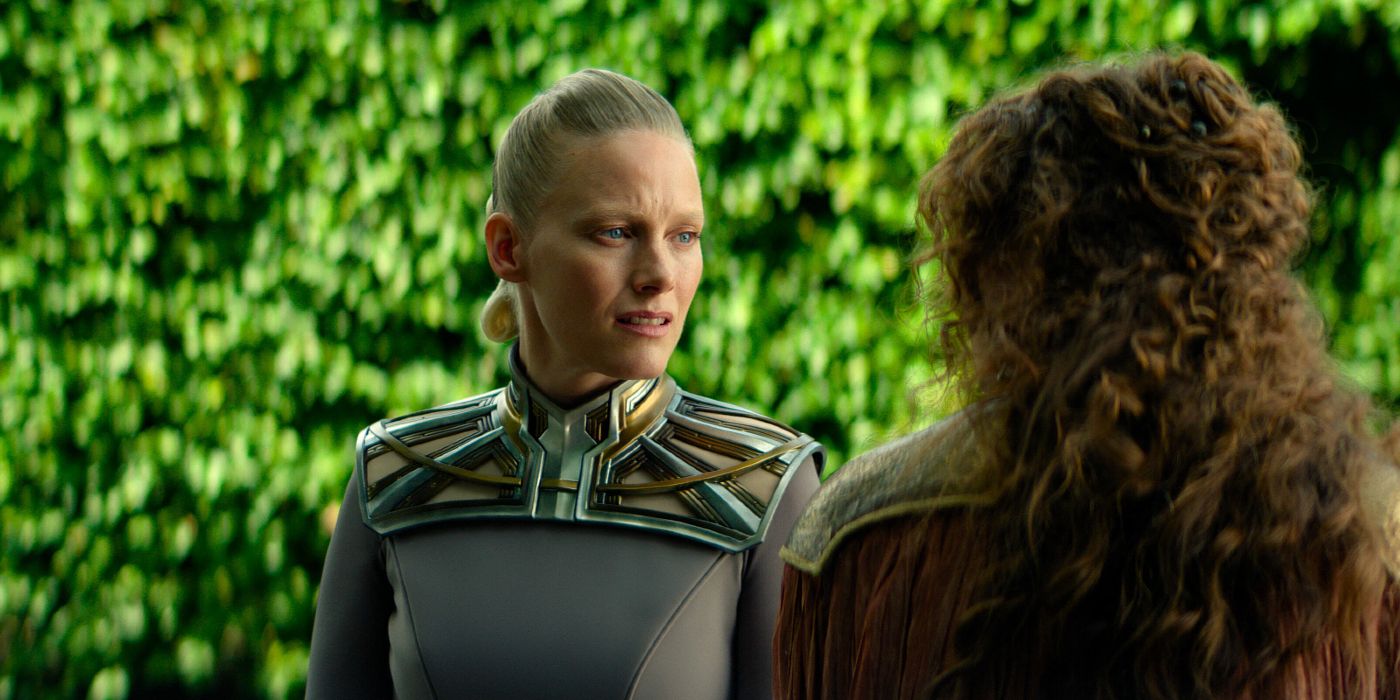
As a huge sci-fi fan, I can honestly say Isaac Asimov basically defined the genre. He created so many of the ideas and themes we still see in science fiction today, influencing tons of writers. His Foundation series is a true masterpiece – even Tolkien, who was writing Lord of the Rings around the same time, recognized its brilliance! It’s amazing how many attempts were made to adapt it, but the Apple TV version is the first one that really did it justice.
Apple’s adaptation of Foundation differs greatly from Isaac Asimov’s original concept. Asimov’s 1950s vision was limited by the social norms and scientific understanding of the time – things like a lack of female representation and a more conservative approach to technology. To update the story for a modern audience, Apple TV reimagined Asimov’s ideas, focusing on character development and the style of high-quality, contemporary television dramas rather than the speculative theories popular in the mid-20th century.
The Galactic Empire Came to the Forefront with the Cleonic Dynasty
One major change from Isaac Asimov’s original novels is the expanded role of the Galactic Empire. Where Asimov presented the Empire as a fading historical power, the TV series keeps it central to the story. The introduction of the Cleonic Dynasty helps achieve this. Unlike the books, where Emperors are rarely seen and have limited impact, the show gives them a more prominent role, though the predictions of psychohistory still drive much of the plot. Even with their presence in the prequels, the Emperors in Asimov’s work aren’t as powerful as they are in the TV series.
After reigning for twelve generations, the three brothers – Dawn, Day, and Dusk – now oversee the fading of the galactic Empire. The Empire’s practice of cloning a single ruler over centuries perfectly illustrates the dangerous lack of change Hari Seldon predicted, demonstrating how the Empire’s downfall was caused by repeating the same mistakes. This allows viewers to witness psychohistory in action: a society stuck in its ways cannot move forward.
What’s truly concerning is that each copy of the original individual starts to change and develop independently, threatening the Cleonic Dynasty with eventual disappearance. The actions of Brother Dusk – eliminating any future Cleons and killing Day – seem to have brought the Galactic Empire to the brink of collapse. Dusk plans to rule as Brother Darkness, which is ironic because, just as Seldon predicted, this will ultimately lead to his own downfall.
Several Central Male Characters Are Satisfactorily Gender-Swapped
Changing the genders of characters in updated stories is a controversial practice. Some people criticize it, arguing it changes the core of the original narrative, while others defend it as a way to include more female characters. For example, in the series, a key character named Arkady Darell, a 14-year-old girl and the granddaughter of Toran and Bayta (characters first seen in Season 3), plays a significant role.
However, the TV version of Bayta Darell differs significantly from the books, as she’s revealed to be the villainous Mule. Making a woman the most dangerous character in the Foundation story provided a compelling contrast to the show’s other changes, like reimagining Salvor Hardin, Gaal Dornick, and Demerzel as different genders. These three characters are all vital to the plot, especially Gaal and Demerzel.
In the original books, Gaal Dornick serves mainly as a stand-in for the reader, learning about the concept of psychohistory. However, the TV series reimagines Gaal as a woman with compelling internal struggles between her rational and emotional sides, making her a key character in the story. The robot Daneel Olivaw, who appears as Demerzel in the show, wasn’t a major part of Asimov’s original Foundation trilogy—he only appeared in the earlier stories. The series gives Demerzel a sympathetic and heartbreaking past, which could ultimately connect back to the ending Asimov intended, if the show continues in that direction.
The Vault Becomes a Mystical Element That’s Still Not Explained
The Time Vault, eventually renamed the Seldon Vault, held pre-recorded holographic messages from Hari Seldon. Because Seldon had foreseen the major crises facing the Foundation, people on Terminus could use these messages to verify that events were unfolding as psychohistory predicted. Importantly, Seldon didn’t offer any direct advice or guidance – he appeared only as a hologram, with no physical presence.
The Vault has been redesigned as something enigmatic and almost otherworldly, operating outside the normal rules of physics. It floats in the air, emits a constant hum, generates strange force fields, and seems to whisper to certain people. Apple intentionally makes the Vault feel like a blend of cutting-edge technology and something divine, leaving those who encounter it thoroughly puzzled.
The Vault seems to operate on principles beyond our current understanding, almost like it can predict the future using incredibly advanced, and somewhat mysterious, quantum technology. It’s capable of astonishing feats. As seen in the series, the Vault instantly transports the entire population of Terminus to a new location, New Terminus. Fans are aware that Seldon’s Vault is now connected to the Prime Radiant, a key scientific tool that has been significantly updated from the original books.
The Mentalics Take on a Significant Role Far Beyond the Novels
As a long-time fan of the Foundation series, I always found the reveal of the Second Foundation fascinating. It turns out Hari Seldon, behind the scenes, quietly set it up with the help of his first psychic assistant. Sadly, he didn’t live long enough to really guide it, but the amazing thing is, it didn’t matter! Psychohistory, the science he created, was strong enough to carry on without him. This Second Foundation was built by these incredibly powerful psychics, and every single member was a master of psychohistory themselves.
Season 2 really focused on the mentalics, portraying them as refugees from different worlds who came to the planet Ignis seeking safety. They weren’t just psychic – they experienced powerful visions, felt others’ emotions, and had strong instincts about the future, pushing the limits of what psychohistory could predict even before the emergence of the Mule.
The characters’ psychic abilities are unevenly portrayed, which throws Seldon’s predictions into further doubt and shifts the story’s focus from a fixed path to one driven by the characters themselves. However, the introduction of Preem Palver and the finale’s direct reference to the Second Foundation on Trantor suggest the show aims to combine its unique elements with the core ideas of Asimov’s original work.
Gaal Dornick and Hari Seldon Never Stop Shaping Psychohistory
As a longtime fan, I always found it interesting how Asimov handled the big picture in the Foundation series. Hari Seldon was meant to fade into the background once the Foundation was set up with Gaal Dornick disappearing after playing his part. Asimov really kept his distance when telling the story of the Foundation’s history, almost like he was observing it from afar – I think he got that style from Edward Gibbon’s work on the Roman Empire. He did create some characters I really connected with, but of course, they couldn’t live forever across all those centuries!
The show prioritized emotional storytelling over cold realism, which meant keeping its central characters alive longer than might have been expected. It focused on building a new future, not just preserving the old one. Keeping Hari Seldon in the story significantly changed its overall message, portraying him as a brilliant planner who also had to confront the unintended downsides of his own plans.
Gaal Dornick, a central character in Foundation, questions the ethical and mathematical principles behind psychohistory. This re-frames how we understand the responses to the Seldon Plan as it begins to deviate from its predicted course. While the book portrays Gaal as a typical human, Apple TV+’s adaptation significantly enhanced their abilities, making them one of the most powerful mentalics, second only to the Mule. Along with Hari Seldon, Gaal survives for centuries using cryosleep.
Religion and Faith Are Just as Important as Science and Technology
Asimov, a staunch believer in reason, saw religion as simply another part of how societies evolved – for better or worse. In his Foundation novels, the most prominent form of ‘religion’ arose on the planet Terminus, where ‘Scientism’ mainly helped the First Foundation gain more power. The TV series hints at this idea with the ‘magicians,’ who spread the teachings of Hari Seldon to less-developed communities on struggling planets.
It must be Luminism, an ancient religion centered around goddesses that existed long before the Galactic Empire. With three trillion followers – a number almost too large to imagine – Luminism possesses immense spiritual power. Theoretically, this faith could disrupt Seldon’s Plan, as such a massive following could counteract the large-scale societal shifts psychohistory depends on.
To add a surprising twist, the series established that Demerzel was deeply spiritual, even more so than the Cleons themselves. The show hinted that, despite being a robot, she actually possessed a soul, while the cloned Cleons were just empty imitations of the original.
Look, this film really understands something crucial about us as people – it’s not just about facts and figures. It acknowledges that faith, in all its forms, is a powerful driving force in history. We see it’s shaped civilizations, both for good and ill, and that’s just as true when you zoom out and look at galactic empires. It’s a refreshing take that recognizes we’re motivated by more than just logic.
Read More
- Five Nights At Freddy’s 2 Review: The Video Game Movie Sequel Limbos Under The Low Bar Set By The First Film
- ‘And Then The Chesty One Comes In.’ SNL’s Cut For Time Sketch Hilariously Reimagined Sydney Sweeney And Zendaya’s Euphoria
- Nintendo Releases First Official Zelda Movie Photos, Revealing Link and Zelda in Costume
- 2025 Officially Marked The Start Of An Era For Spider-Man
- George Clooney Has The Best Reaction To The Viral Louvre Heist Following Ocean’s Eleven Comparison
- I Needed A New Hockey Romance After Finishing Heated Rivalry (And I Already Found The Perfect One)
- Netflix Rolls the Dice on Live-Action Kakegurui Series Renewal for 2027
- Elle Fanning’s Upcoming Apple TV Comedy Continues A Wildly Impressive Streaming Trend
- It’s Been Weeks Since I Watched Freaky Tales, And I’m Still Thinking About That Random Tom Hanks Scene
- JOJOLands Chapter 31 Release Date & Where to Read Manga
2026-01-14 03:14